
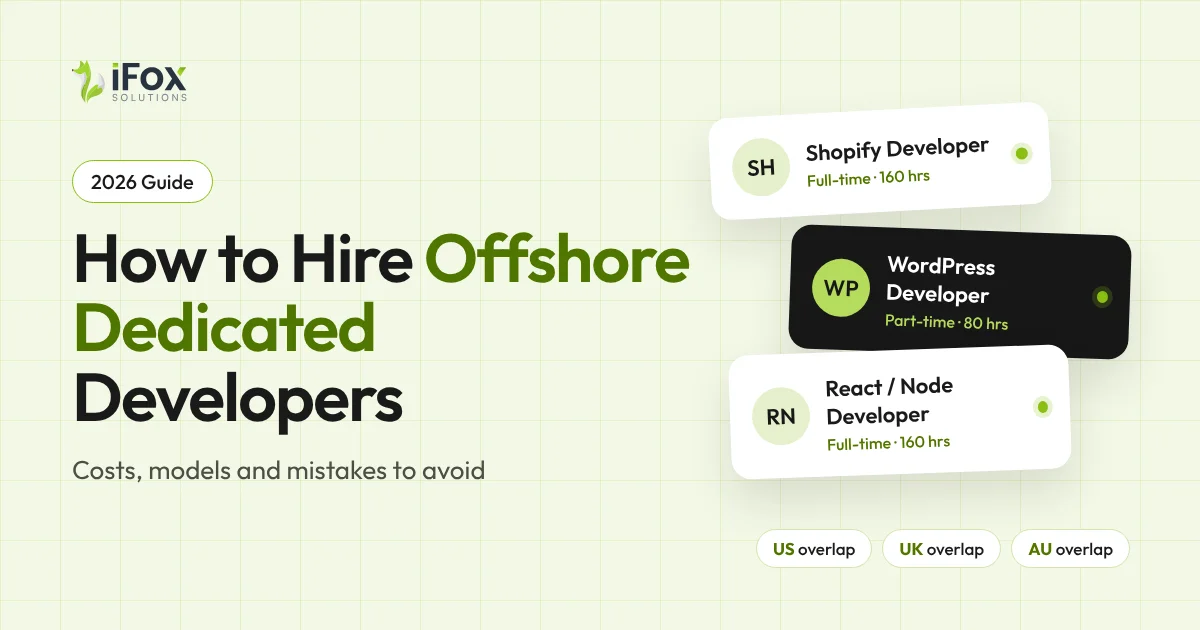
How to Hire Offshore Dedicated Developers in 2026: Costs, Models and Mistakes to Avoid
Hiring an offshore dedicated developer can give you a skilled, full-time team member for a fraction of local hiring costs, but only if you pick the right partner and set it up properly. This guide covers the hiring models, what it really costs, how to vet a team, and the mistakes we see most often, based on more than 12 years of placing developers with brands and agencies in the US, UK and Australia.
What is a dedicated developer?
A dedicated developer works only on your projects, as an extension of your team, for a fixed number of hours each month. You set the priorities and talk to them directly, while the provider handles hiring, payroll, equipment and replacement if someone leaves. It sits between a freelancer, who often juggles several clients, and an in-house hire, who comes with recruitment costs, benefits and long notice periods.
Which hiring model fits you?
| Model | Best for | How you pay |
|---|---|---|
| Fixed-price project | A clearly scoped build with a defined end | Agreed quote |
| Hourly | Small tasks, fixes and ongoing changes | Per hour worked |
| Dedicated part-time | Steady work that doesn't need a full week | Monthly, for a set number of hours |
| Dedicated full-time | Ongoing product work or a constant flow of client projects | Monthly |
If your work is ongoing and changes week to week, a dedicated developer is usually better value than repeated fixed-price quotes.
What does an offshore developer cost?
Rates vary a lot by country, experience and technology, so compare full monthly costs, not just hourly rates. As a real example, here is how we price at iFox:
- Hourly: from $22/hour
- Dedicated part-time (80 hours a month): from $1,099/month
- Dedicated full-time: from $2,099/month
When comparing quotes, ask what’s included: project management, QA, replacement if the developer isn’t a fit, and the notice period. A cheaper rate with no QA and no replacement guarantee often costs more in the end. See our full pricing →
How to vet an offshore development team
- Look for work like yours. Ask for live examples on your platform, whether that’s Shopify, WordPress, React or Node.js, and ideally in your industry.
- Check reviews you can verify. Google, Upwork and other third-party reviews are harder to fake than quotes on the provider’s own website.
- Test before you commit. A trial, a short test task or a technical interview shows you real code and communication. We offer a free 4-day trial, an interview or a test task, whichever the client prefers.
- Ask about their process. Good teams test changes on staging, run their own QA and let you review before anything goes live.
- Confirm ownership in writing. The code and designs should belong to you, and an NDA should cover your project.
- Check working hours. You need several hours of overlap each day for calls and quick fixes.
Mistakes to avoid
- Hiring on price alone. The cheapest rate often means more of your own time spent fixing and re-explaining.
- Skipping the trial. A CV doesn’t show how someone communicates or handles feedback.
- No clear point of contact. You should know who to message when something is urgent, and get a reply within a day.
- Long lock-in contracts. Look for a reasonable notice period, such as 30 days, rather than multi-month commitments.
- No replacement guarantee. If a developer isn’t the right fit, the provider should replace them quickly.
- Vague onboarding. Without access, documentation and a first task ready, the first two weeks are wasted.
Time zones: how to make it work
Offshore doesn’t have to mean slow. Our team in Ahmedabad works 10 AM–7:30 PM IST, which overlaps with the US, UK and Australian working day, and developers can match a client’s full hours when a project needs it. Agree a daily overlap window for calls, and use async updates for everything else.
A simple checklist before you sign
- Seen live work on your platform
- Checked third-party reviews
- Completed a trial, interview or test task
- Agreed hours, overlap time and point of contact
- NDA signed and code ownership confirmed
- Notice period and replacement terms in writing
- First tasks, access and documentation ready for day one
The first two weeks
Treat a new dedicated developer like a new team member. Share access and documentation on day one, start with a small, well-defined task, review their first pieces of work closely, and set up a short daily check-in. By the end of week two, you’ll know whether the fit is right.
FAQ
With an established provider, often within a few days. At iFox, a developer can start within 48 hours of the go-ahead.
Yes, if you choose an established team, sign an NDA, confirm code ownership and use a trial before committing. Check verifiable reviews and the provider’s track record.
A dedicated developer works only on your projects with the provider’s support behind them, including QA and replacement. A freelancer usually works alone and often for several clients at once.
Yes. Part-time dedicated plans, such as 80 hours a month, suit steady work that doesn’t need a full-time developer.
Ask for a replacement guarantee before you sign. We replace a developer within 7 days if they aren’t the right fit.